
Shachah
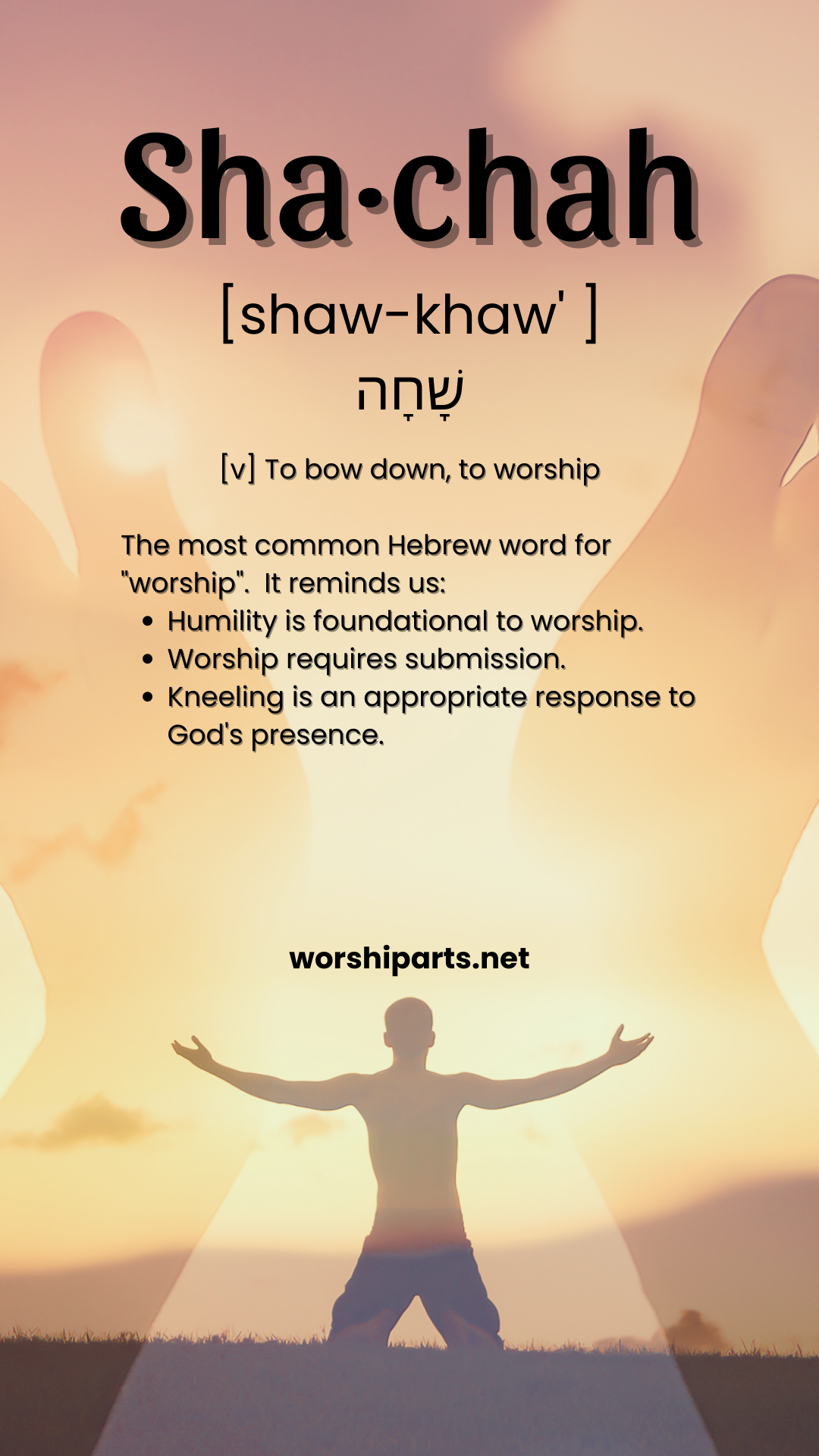
Shachah is a Hebrew word that calls us to bow down before our God. Here is a complete list of the worship words on my site:
Worship Terms
Worship – What is the meaning of the English word “Worship?”
Proskuneo – The primary Greek word for worship
Shachah – The primary Hebrew word for worship
Halal – A Hebrew word for crazy exuberant praise
Shabach – A Hebrew word for loud praise
Tehillah – A Hebrew word for song of praise
Zamar – A Hebrew word for making music accompanied by strings
Yadah – A Hebrew word for extending the hands in thanksgiving and praise
Towdah – A Hebrew word for a thanks offering
Barak – A Hebrew word for kneeling before God in humble submission
Hidden Meaning in Psalm 100:4 – See how understanding these words enhances the meaning of this popular praise verse.
History of the Word “Worship”
In my first page on worship terms, What is Worship?, I discussed the English word “worship” and its meaning: “to ascribe worth to a person or object.” Although understanding the English meaning is valuable, even more important to our understanding of the word “worship” is its biblical usage.
History of the Word “Worship”
The Old Testament was written in Hebrew, and the most common Hebrew word translated as worship is “shachah.” According to Strong’s Concordance, “shachah” means “to bow down.” What is interesting about this word is that it may be translated as either “to bow” or as “worship” depending on the context.
For example, we find in Genesis 23:7 that Abraham “bowed” before the Hittites. In this case, the context lets us know that Abraham was physically bowing as a respectful greeting. Just one chapter before, in Genesis 22:5, Abraham informs his servant that he and Isaac will go up on the mountain and “shachah.” In this case, the context makes it clear that Abraham intends to worship on the mountain.
Application
Worship [shachah] the Lord in the splendor of holiness;
tremble before him, all the earth!
Psalm 96:9
In the Hebrew mind, there was a very close relationship between bowing down and worshiping. Here are three ways we can apply this truth to our lives:
Three Questions to Ask
by Jerry Wyrick